
How ASP.NET Core Middleware Helps Enterprise Applications Manage Requests at Scale?
Handling an incoming HTTP request in high-throughput corporate systems is rarely as easy as sending it straight to a business logic controller or database query. Before a single line of domain logic runs, modern web applications—which handle thousands of concurrent requests per second under peak loads—must enforce security, guaranty auditability, manage bandwidth, and guarantee fault tolerance.
ASP.NET Core Middleware serves as the fundamental architectural framework for fulfilling various non-functional requirements inside the.NET ecosystem. Enterprise applications uphold stringent operational requirements without overcrowding core business code by grouping cross-cutting issues into a modular, highly efficient processing pipeline.
The Request Pipeline Architecture
An ASP.NET Core middleware component sits between the web server (Kestrel) and the endpoint handlers (Controllers or Minimal APIs). Arranged in a chain (or pipeline), each middleware component receives an HttpContext, executes specific logic, and decides whether to:
- Pass the request to the next middleware component in the chain (
await _next(context)). - Short-circuit the request, halting further pipeline execution and immediately returning a response to the client (e.g., returning
401 Unauthorizedor429 Too Many Requests).
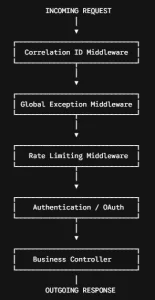
Core Enterprise Use Cases for Pipeline Middleware
1. Distributed Tracing & Correlation IDs
In microservice architectures, a single user action can trigger requests across dozens of internal services. Middleware intercepts every incoming request, checks for an X-Correlation-ID header, and generates a new GUID if one is missing.
By injecting this ID into the logging context (via Serilog or OpenTelemetry), every log message generated during that request’s lifecycle—including downstream calls—carries the same correlation footprint for debugging.
2. Centralized Fault Tolerance & ProblemDetails
Rather than wrapping every controller action in repetitive try/catch blocks, enterprise apps utilize global exception-handling middleware (such as ASP.NET Core’s IExceptionHandler).
When an unhandled exception occurs anywhere in the stack, the middleware catches it, logs the full trace securely to internal monitoring tools (such as Application Insights or Datadog), and returns a standardized JSON response to the user, ensuring sensitive infrastructure details are never leaked.
3. Distributed Rate Limiting & Bot Protection
To protect backend microservices and databases from Denial of Service (DoS) attacks or automated scraping, enterprise systems place rate-limiting middleware early in the pipeline. Using algorithms like fixed-window or token-bucket backed by Redis, the middleware verifies the client’s IP or authenticated identity. If quotas are exceeded, the request is short-circuited instantly with an HTTP 429 status code, saving downstream compute resources.
4. Edge Security & Token Validation
Middleware validates incoming JSON Web Tokens (JWTs) or OAuth cookies, inspecting signatures and evaluating user roles or scopes. If a request lacks required credentials, execution stops at the security middleware layer—ensuring unauthorized traffic never reaches internal business domain models.
Production-Grade Enterprise Middleware Implementation
Below is a complete, production-ready example of a custom Correlation ID Middleware class in C# using modern ASP.NET Core conventions.
1. Middleware Implementation
2. Pipeline Registration Order in Program.cs
In ASP.NET Core, middleware registration order is critical. Middleware executes in the exact sequence it is added to the pipeline.
Architectural Best Practices for Enterprise Pipelines
- Keep Middleware Fast: Because every request flows through the pipeline, avoid heavy, blocking synchronous calls (
.Resultor.Wait()). Always useasync/await. - Order Matters: Place exception handlers and logging wrappers at the top of the pipeline so they can capture errors and attach context for all subsequent steps.
- Avoid Duplicating Business Logic: Keep business rules (e.g., domain calculations or database updates) out of middleware. Middleware should strictly focus on infrastructure concerns, routing, and request/response metadata.
By leveraging a well-structured middleware pipeline, enterprise .NET applications achieve high resilience, comprehensive observability, and strict security isolation at scale.
ASP.NET Core 10.0 Hosting Recommendation
HostForLIFE.eu
HostForLIFE.eu is a popular recommendation that offers various hosting choices. Starting from shared hosting to dedicated servers, you will find options fit for beginners and popular websites. It offers various hosting choices if you want to scale up. Also, you get flexible billing plans where you can choose to purchase a subscription even for one or six months.